Contents
0%Hey!
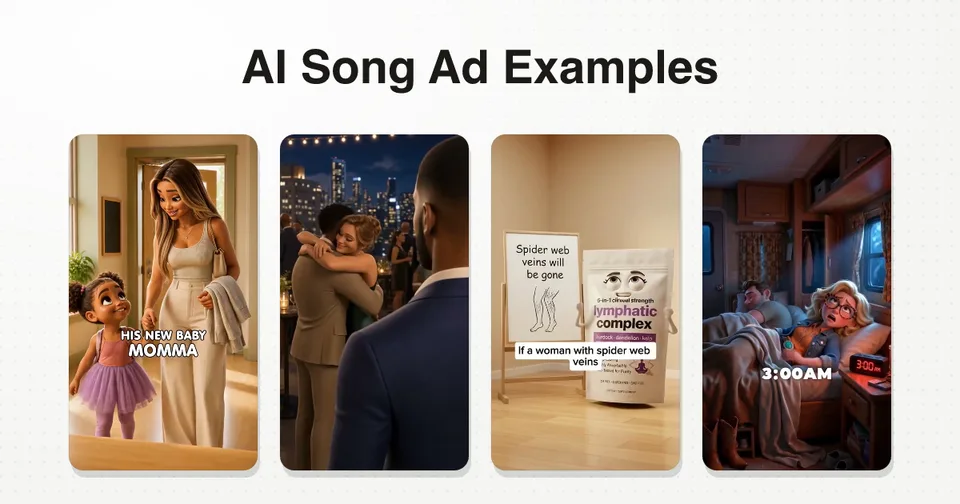
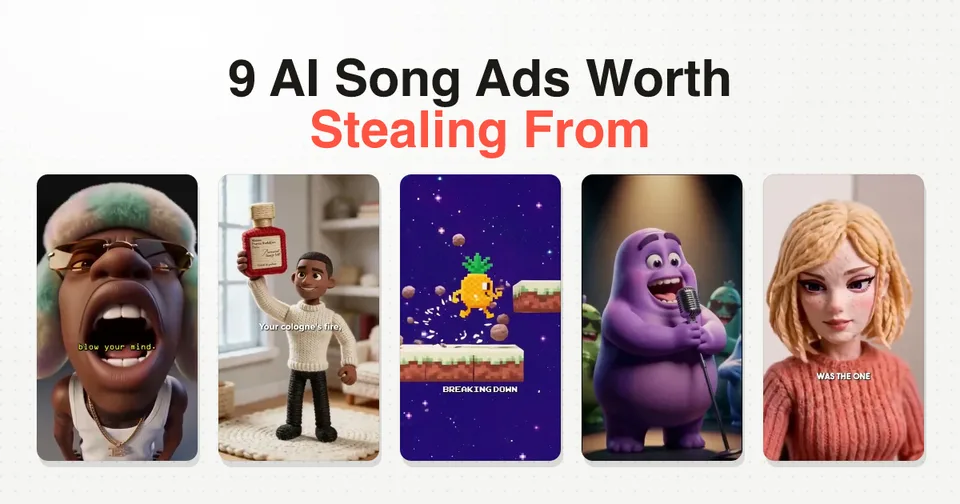
This is the swipe file I keep open while I write song ads: nine AI singing ads, nine different products, nine different looks. Watch them with the sound on, here or on the swipe file page where all nine sit in one grid.
Want to make your own instead of only studying these? Grab the free song‑ad skill file. It turns the whole format into a workflow an AI agent can run for you.
1. RYZE Superfoods: the confession hook
RYZE Superfoods runs around 4,700 ads in the Meta Ad Library (as of September 17, 2026), and a lot of the ones that stay live longest are songs. This one opens on a confession about a guy who smokes every night, unbleeped, before the product is anywhere on screen.
The promise lands in the next line: one cup of RYZE every morning for a few months. Notice that the character wears the brand, literally. RYZE is printed on his chest, so every frame is branded without a single logo card.
Then the ad draws the claim instead of saying it: a glowing line runs from the gut up to the brain while the lyric mentions focus. That is the move worth stealing. A sung claim that gets a picture is a claim people remember.
2. Penrose Skin: name the competitor in the first verse
"Your cologne is fire, but it is dead by noon." Second person, one sentence, a problem the buyer has already noticed himself. No persona setup, no story runway.
Penrose Skin then does the thing most brands are scared of: it crochets Tom Ford, Creed Aventus and Baccarat Rouge 540 and puts them on a stool. Rendering the whole world in yarn is what makes the competitor callout feel playful instead of aggressive.
The mechanism verse is one line of chemistry ("cologne evaporates when it hits the air, oil bonds") and the payoff is a text message, not a bottle. Problem, mechanism, social proof, in under 50 seconds.
3. True Nutra: a video game in the middle of the ad
This one opens on glossy 3D characters in a neon 80s set, then cuts into a fake arcade cabinet called Lymphatic Rush, where a pixel-art pineapple (bromelain) smashes through blocks with a health bar running across the top.
That genre switch is the whole trick. The mechanism section of a supplement ad is where people leave, so this ad changes format exactly there and buys another 20 seconds by turning biology into a level.
It also reuses the same character before and after, in the same outfit, so the transformation reads instantly. Both halves of the ad are the same woman, which is the cheapest continuity device there is.
4. YURI: state the age, name the villain
"I am 56." First line, first second. A specific age is a targeting instruction disguised as lyrics: the right buyer leans in and everyone else scrolls, which is exactly what you want at the top of a cold campaign.
The story stakes are social, not medical. Her ex brings his 31 year old girlfriend to her daughter's day, and a woman named Karen walks in on her in the bathroom. Giving the antagonist a name costs nothing and makes the whole verse quotable.
The product demo is the peel of a collagen mask in close up, and the last line sung is the call to action itself. The ad never stops being a song to ask for the click.
Every pattern on this page is encoded in the free song‑ad skill for Claude: the lyric structure, the character sheet, and the shot list that keeps one face across every scene.
5. True Nutra again: the 15 year number
Same product as number 3, completely different build. Needle felted wool dolls, a hook that is two numbers, and a symptom so specific it does the qualifying for you: sock marks that stay on the skin, legs hidden for 15 years.
The second number is the promise window, "here is what happened after the 30 days," which sets up the whole rest of the ad as a payoff the viewer is waiting for.
Then the ingredients are laid out as felted botanicals on a wooden board, and the vein cutaway is knitted too. When the craft style is consistent even inside the body, the ad reads as one object instead of a stock montage. Worth comparing side by side with number 3: one product, two art directions, two audiences.
6. levelfifty: third person, named protagonist
"This is Claire. She turned 50." The narrator is outside the story, which is the opposite of the YURI ad, and it works for a different reason: the viewer gets to watch someone instead of being told she is them.
The setup shots are tiny and concrete. A 3:00 am clock, a shirt soaked through, losing it at the self checkout. Three specific scenes beat one general claim about hormones every time.
The turn is a shelf of supplements she cannot choose between, which reframes the product as the end of a search rather than one more bottle. That is a strong angle for any crowded category.
7. Bioblade: no human in the ad at all
A purple blob character sings a recovery ad on a lounge stage while other monsters watch. There is no human on screen for the entire ad, which quietly solves the two problems people worry about most with AI video: uncanny faces and hands.
It also unlocks the visuals. Tight muscles become a knotted rope, heat melts the knot, and glowing orange fascia lines sit on the character's back like a diagram. A mascot body can be drawn on. A real model cannot.
The product, a handheld recovery tool the ad calls the Bioblade, appears late and only after the tension metaphor has paid off.
8. MERODA: the drawer of dead products
Felted wool again, beauty this time, and the hook is a single prop: a drawer of foundation bottles that cost a week's pay. Every buyer in this category has that drawer.
The count is the spine of the song. Forty seven tries, and the forty eighth was the one. A number that goes up through the lyrics gives a two minute ad a reason to keep playing.
The ad also drops in a pattern interrupt with nothing to do with foundation: a group of felted cats taking a selfie. It costs one scene and it is the frame people screenshot.
9. True Nutra: the sung ingredient list
The best specimen in the file. A talking product bag introduces the problem with a flip chart, then every ingredient walks on and sings its own job: "I clean the clogged drains in your legs," "I am bromelain," "I am dandelion and I am kelp."
This is two proven formats stacked. The ingredient list ad gives you structure, the song gives you rhythm, and together they turn a spec sheet into a chorus. One job per ingredient, one visual metaphor per job, nothing else.
The payoff shot is the buyer wearing shorts in a park, and the closing line is the CTA, sung. There is a full breakdown of this one in the ingredient list crossover post.
What all 9 have in common
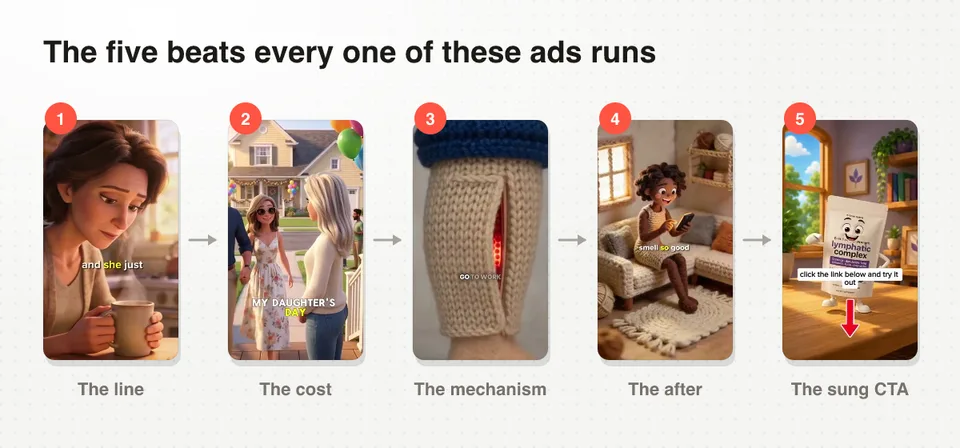
The five shots of an AI song ad: the line, the cost, the mechanism, the after, the sung CTA
Nine products, nine art directions, one skeleton:
- The first line is a confession, not a product. An age, a name, a number, or a problem stated in second person. Nobody opens on the bottle.
- The story has a social cost before it has a symptom. Someone walks in, someone watches, someone is at a party. The physical problem is the reason, the humiliation is the hook.
- The mechanism gets drawn. A cutaway, a glowing line, an arcade level, a knot melting. The verse that would be boring as text becomes the most interesting shot in the ad.
- One character carries the whole thing. Same face, same outfit, before and after. That is what makes a two minute ad feel like one film.
- The CTA is sung. The ad never breaks character to ask for the click.
The other thing they share: length. Most of these run between one and three minutes, and song ads in the wild go up to five. That only works because the song holds the pacing, which is why the song gets made before any visual (the full workflow, step by step).
Frequently asked questions
What is an AI song ad? A short music video that sells one product. A generated character sings the lyrics in some shots, B-roll covers the rest, and the song carries the whole story instead of a voiceover.
How long should a song ad be? Longer than you think. The ads in this file run from 47 seconds to just over three minutes, and the format holds attention up to about five. Pick the length your song needs, then build to it.
Which AI model makes a character sing on beat? The song has to go into the model as an input, not as timestamps in a prompt. MiniMax H3 Max takes an audio reference alongside the image references, which is how the lip sync stays on the beat. The details are in the Suno walkthrough.
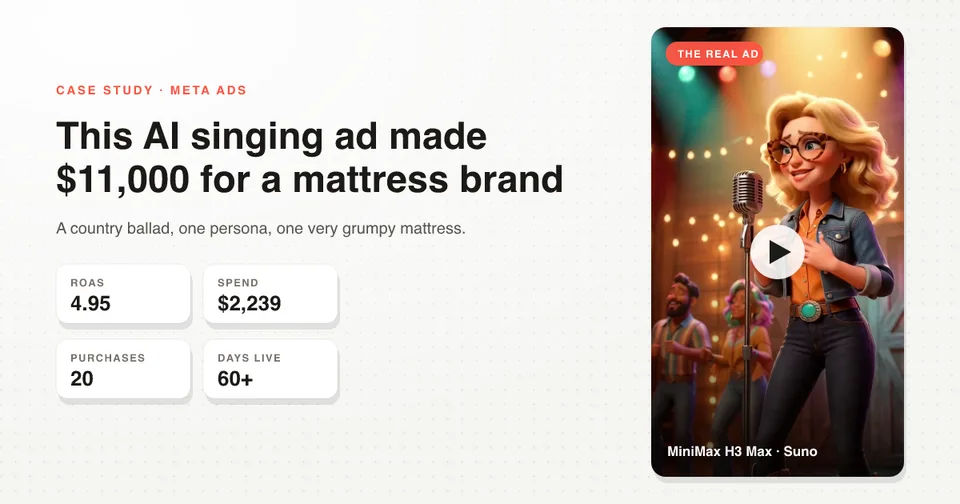
Do song ads only work for supplements? No. This file alone covers mushroom coffee, body butter, foundation, a collagen mask and a recovery tool, and we have run the format for a mattress brand too. See the mattress case study for what it did on Meta.
Where do I find more of these? The Meta Ad Library is public and free. Search a brand, sort by impressions, and look at what has been active longest. How to read an ad account from the outside walks through it.
Next Steps
Pick the ad on this page closest to your product, write your version of its first line today, and keep the rest of the structure. That first line is 80% of the work. All nine are also on the song ad swipe file page if you want to rewatch them back to back.
None of the nine is from Resilia, the brand a lot of people are talking about for this format right now. I cover what a Resilia ad really is in its own post.
When you want to build one, the free song‑ad skill for Claude has the lyric structure and the shot rules, and you can make the whole ad in Starpop in one chat: the song, the character, the storyboards and the generations. The video walkthrough is in the sidebar.