Contents
0%When people hear “AI-generated ad,” they often imagine something that looks cheap, strange, or obviously fake. Like weird hands, unnatural movement or a robotic voice.
Slop content exists. But it no longer represents the limits of current technology.
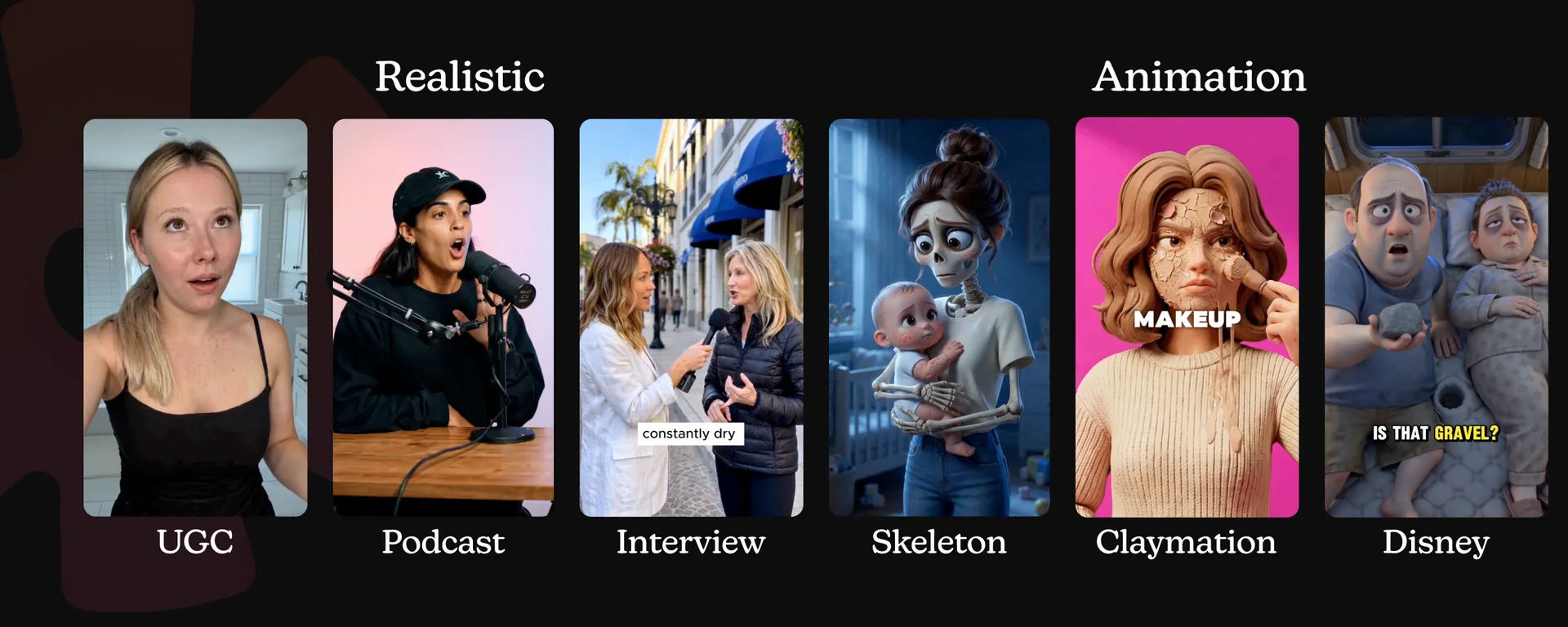
Last month, we made and ran more than 100 fully AI-generated video ads for our clients on Meta Ads. Some looked as polished as traditionally produced creative. And some performed way better than their existing creatives.
In this essay, I’ll share my beliefs about:
- What fully AI-generated advertising can do today that changes the economics of creative production, experimentation, and distribution
- Why human judgment and the ability to direct AI will become more valuable as execution becomes automated
- How creative AI agents will reshape marketing and why we are building Starpop around that future
Fully AI-generated does not mean fully AI-directed
When we say “fully AI-generated,” we mean AI produced most or all of the media inside the ad: images, video, actors, voices, music, sound effects, product shots, and visual effects.
An entire video can now be made without a physical camera, studio, or actor.
But the production can be fully AI-generated while the thinking behind it remains human.
Someone still needs to decide who the ad is for, which problem it should address, what it should say, and how it should make the viewer feel. Someone needs to brief the models, evaluate the results, and decide what is ready to publish.
The best AI ads start before we generate anything
We could turn an idea into a video in a fraction of the time required for a traditional production. The results could look impressive from a visual perspective. But a beautiful video could still communicate nothing important.
It might attract the wrong audience, describe the product without explaining why anyone should care, or never turn curiosity into buy intent.
A good ad still needs a relevant problem, a clear promise, a strong angle, and a reason to believe.
Before generating anything, we need to know:
- Who are we trying to reach?
- What problem are they experiencing?
- What do they believe about the available solutions?
- What would make this product relevant to them?
- What objections might stop them from buying?
- Why should they trust this brand?
AI has not made those questions less important. By making production faster, it has made weak thinking easier to expose.
We research the audience by reading reviews, studying competitor ads, searching Reddit, and watching how people discuss the problem on TikTok, Instagram, and YouTube.
We study the business too. What makes the product different? Which benefits matter most? What claims can the brand support? Who is already buying, and why?
Then we turn those insights into angles, hooks, and ICPs.
If the foundation is wrong, automation only produces the wrong ad faster.
Cheaper production does not remove the need for taste
Some people imagine businesses generating endless ads with almost no human involvement.
We are not there today. I am also not convinced that removing people from the creative process should be the goal.
Given the same generic information, AI tends to produce familiar outputs. The hooks sound alike. The scripts follow the same structures. The visuals repeat patterns already common in the training data.
A person can introduce something different: an observation from a customer conversation, an unusual product insight, a cultural reference, a contrarian belief, or an emerging format the models have not yet absorbed.
AI can help uncover and develop these inputs. It cannot supply a differentiated point of view when nobody has one.
The human role is not disappearing. It is shifting from manual production toward planning, directing, evaluating, and deciding.
Humans should own the intent, taste, context, and accountability. AI should handle more of the repetitive execution.
More products make distribution more valuable
AI is making products easier to build. Software can be created faster, stores launched more quickly, and research and operational work accelerated.
That makes distribution more valuable, not less. Even a great product needs a way to be discovered and understood.
Advertising is one of the clearest places where AI can help. It gives smaller teams access to production capabilities that previously required actors, studios, editors, and much larger budgets.
But again, the biggest opportunity is not cheaper production. It is the wider range of ideas a business can explore.
Directing AI will become a normal professional skill
Models and workflows are changing quickly. New models appear, existing ones become cheaper, and new input types create workflows that were impossible months earlier.
The durable skill will not be memorizing the perfect prompt for one model. That knowledge expires too quickly.
People will need to know how to break a goal into tasks, provide useful context, select and connect tools, evaluate the result, verify important information, and recognize when human intervention is necessary.
The most valuable operators will not be those who manually complete every step. They will be those who understand the objective well enough to direct agents and judge their work.
Why we are building Starpop
Our work with clients showed us how much knowledge sits between an idea and an effective AI-generated ad.
Someone has to understand the brand, product, audience, and creative objective. Someone has to research the customer, develop the angle, write the script, choose the models, and combine their outputs.
Much of that knowledge lived in our heads.
That is why we are building the Starpop Creative AI agent: to make it accessible to more marketers.
A marketer should not need to follow every model release or understand the prompting behavior of every video generator. The agent can track the technology and translate creative intent into instructions for specialized tools.
The goal is not to remove the marketer from marketing.
It is to give a thoughtful marketer access to the research breadth, technical knowledge, and production capacity of a much larger creative team.
Fully AI-generated ads are only the beginning
The future of advertising is not a machine producing infinite creative without human thought.
It is a person with taste, customer understanding, and conviction directing agents that understand the tools of the creative process.
Those agents will handle more research, tool selection, generation, adaptation, and repetitive execution. People will spend more time choosing the direction, evaluating the work, and deciding what deserves to exist.
The difficult and valuable parts remain: understanding people, finding the right message, developing a point of view, and knowing when an idea is worth showing to the world.
Fully AI-generated ads are here to stay.
The next challenge is making sure they are worth watching.