Contents
0%Hey!
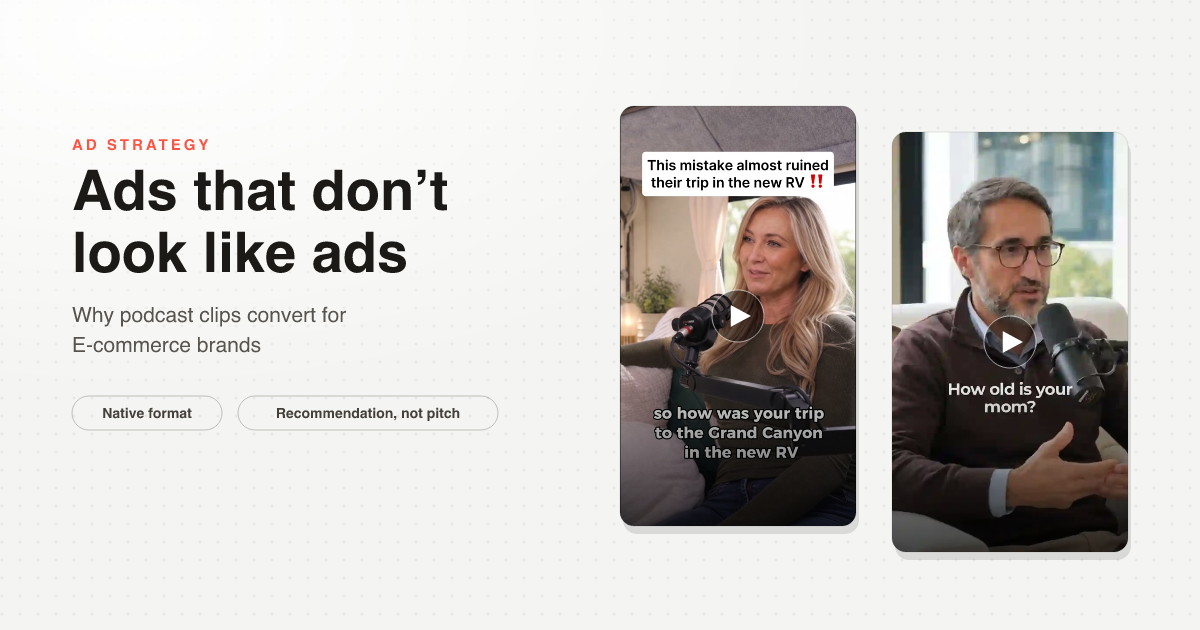
The best-performing ad format right now does not look like an ad at all. It looks like two people talking on a podcast.
The format in 30 seconds
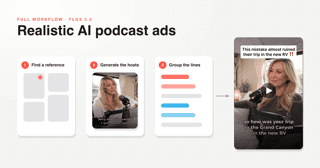
Two hosts in an RV, one complains she cannot sleep on trips, the other reveals the mattress that fixed it. Every frame and every voice is AI-generated, and the whole thing is a mattress ad.
Why a fake conversation beats a real ad
Podcast clips are pre-trusted. Your feed has trained you: podcast framing means someone is sharing an opinion, not selling. The mics, the casual posture, the caption style all signal "content", so the viewer's ad-blindness never activates.
A recommendation is not a pitch. When Host B says "we got ours from this US-based company", she is not talking to you. Overheard recommendations carry the weight of advice between friends, which no direct-to-camera script can buy.
The problem gets airtime before the product. A conversation naturally spends its first half on the pain ("Jerry and I just couldn't get a good night's sleep"). That is textbook problem-aware selling, and the dialogue format makes it feel organic instead of formulaic.
With today's video models, realism is no longer the bottleneck. About 80% of a believable podcast ad is the script. If the dialogue reads like something two humans would say, the format does the rest.
What your version needs
- A discovery arc: Host A owns the problem, Host B has already solved it, the product arrives as her answer.
- Real customer language: build the dialogue from how buyers actually describe the pain in reviews and Reddit threads, not from your landing page.
- One concrete proof point: a sleep trial, a number, a detail only a real owner would know.
- A scene that matches your audience: a women's podcast in an RV sells RV mattresses; a garage-gym show sells pre-workout.
Where brands get it wrong
The pitch arrives too early. If the product is named in the first 10 seconds, you made a normal ad with microphones in it.
The dialogue is too clean. Real conversation has interruptions, "oh yeah, same", and half-finished thoughts. Polished lines are the tell that kills the format.
The frame is too perfect. A pristine 9:16 generation reads as AI. Cropping to the slightly tight, letterboxed frame real podcast clips use makes it native to the feed.
The entire workflow, from conversation script to consistent AI hosts to the editing fixes, is packaged as a free skill file on the AI podcast ad page.
Study the format before you make one
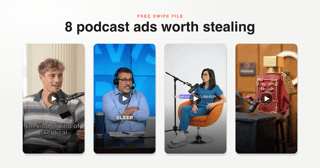
Eight strong examples, from skeptical-friend conversations to a claymation product giving an interview, are collected in the podcast ad swipe file. Watch how each one hides the pitch inside a conversation.
For the full build process, the step-by-step workflow I used for the RV mattress ad above is in the AI podcast ad tutorial.
Next Steps
Write the 6-line conversation for your product this week: the complaint, the empathy, the reveal, the proof point. Then run it through the free skill file, and watch the full video walkthrough in the sidebar.