Contents
0%Hey!
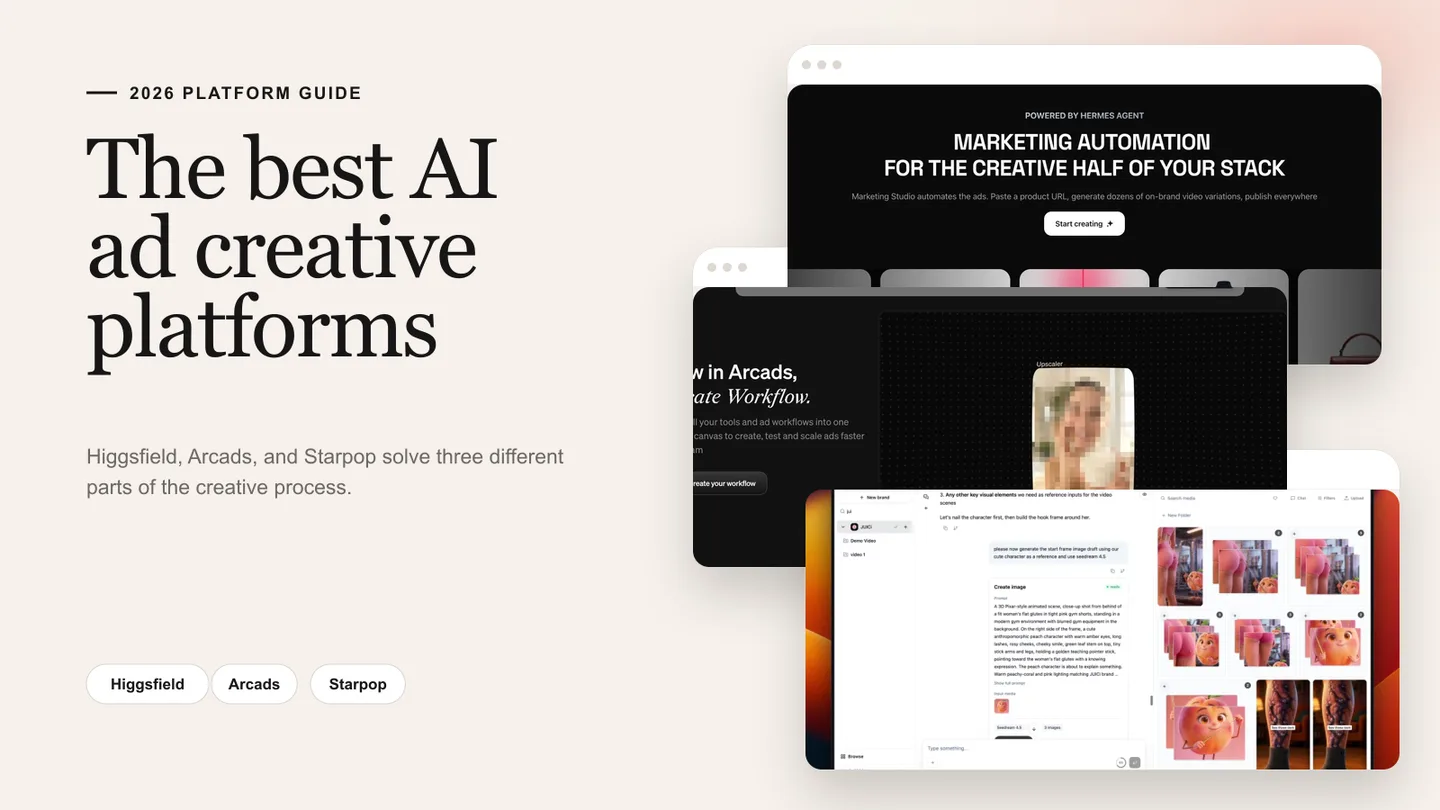
I keep seeing Higgsfield, Arcads, and Starpop put into the same bucket. All three can create AI ads, but after you get past the model lists and demo reels, they are built around three different ideas of what the hard part actually is.
The short version:
- Higgsfield is best when you want a broad, visually ambitious AI production studio.
- Arcads is best when you already have a script and want to produce actor-led UGC variations quickly.
- Starpop is best when you want an AI creative agent to research, plan, script, and produce the campaign with you.
The right choice depends less on which platform has the longest feature list and more on where your creative process currently breaks down.
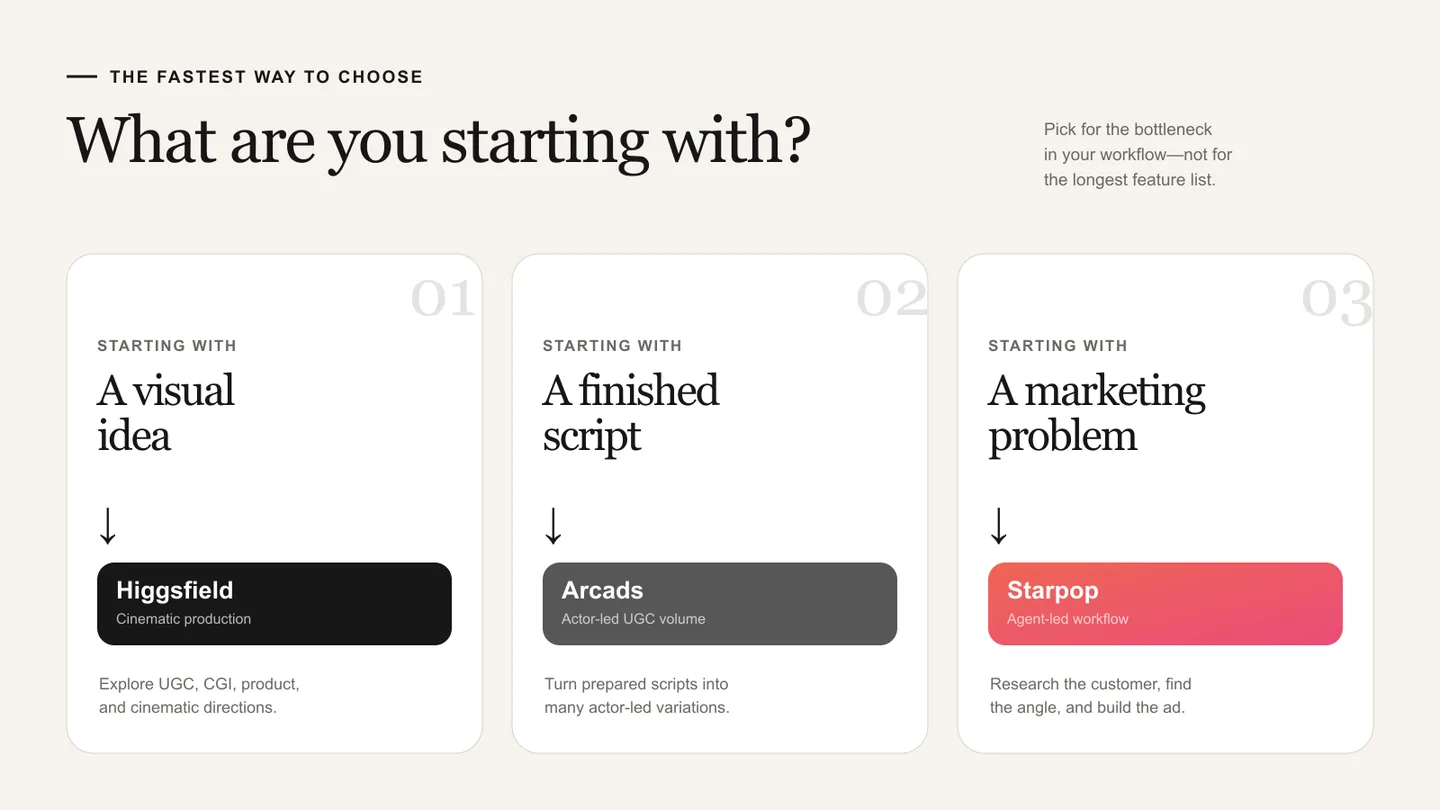
Decision guide showing Higgsfield for visual ideas, Arcads for finished scripts, and Starpop for open-ended marketing problems
Quick comparison
| Platform | Best for | Main strength | Main tradeoff |
|---|---|---|---|
| Higgsfield | Cinematic ads, product visuals, and experimentation | Broad visual range and strong production controls | The number of modes and tools can make the workflow feel complex |
| Arcads | Actor-led UGC ads and rapid variations | Large actor library and structured production workflows | You still benefit from arriving with a strong angle and script |
| Starpop | E-commerce creative strategy and campaign creation | One agent combining research, copywriting, and media generation | Less direct if you only want a quick, isolated generation tool |
Higgsfield: best for visual range and cinematic production
Higgsfield feels the most like a broad AI production studio.
Its Marketing Studio can turn a product URL into UGC, product reviews, unboxings, tutorials, virtual try-ons, CGI spots, and more cinematic commercials. It also offers reusable avatars and batch variations across formats and channels.
The biggest reason to choose Higgsfield is range. You can begin with a basic product image and explore several creative directions without leaving the ecosystem.
Higgsfield makes the most sense for:
- Visually ambitious product ads
- CGI and cinematic concepts
- Fashion and virtual try-on content
- Teams producing several different creative styles
- Creators who want granular control over how a video looks
Its URL-to-ad workflow can handle the script, shots, camera direction, and edit. The wider suite adds image creation, video generation, character consistency, lip sync, and visual editing. Higgsfield's Marketing Studio currently positions itself around UGC, professional product content, and TV-style spots from the same workflow.
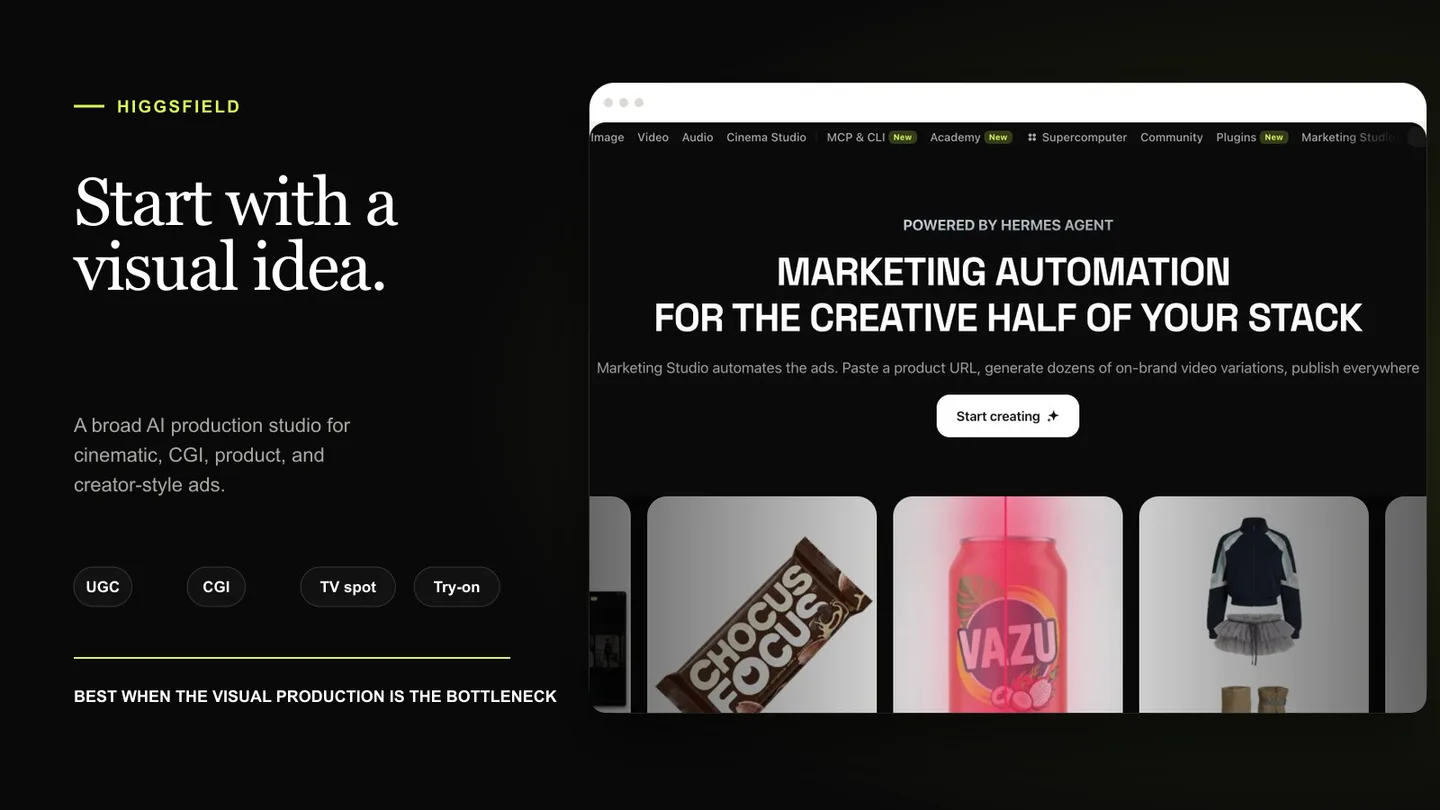
Higgsfield Marketing Studio positioned as the platform for visual ideas and cinematic production
The tradeoff is that breadth creates complexity. If your actual goal is simply "make ten talking-head ads from this script," Higgsfield may give you more creative surface area than you need.
My verdict: Choose Higgsfield when visual production is the hard part. It is particularly compelling when you want to explore cinematic ideas instead of staying inside a standard UGC template.
Arcads: best for actor-led UGC at scale
Arcads made its name around a simple proposition: choose an AI actor, give them a script, and create a large volume of UGC-style ads without coordinating real creators.
That is still its clearest strength. Arcads promotes a library of more than 1,000 AI actors alongside the ability to create custom avatars. It also provides captions, transcription, translation, voice changes, actor replacement, video extension, B-roll, and product showcases.
Arcads is a strong fit for:
- Performance teams testing many actor and hook combinations
- Mobile apps and DTC products suited to face-to-camera ads
- Agencies producing localized variations
- Teams that already have scripts and repeatable frameworks
- Brands that prioritize production volume
Its guided presets are useful when you do not want to configure every model and editing step manually. Its newer workflow canvas also brings its tools into a more flexible, team-oriented production environment. Arcads' current platform overview shows how far it has expanded beyond basic talking avatars.
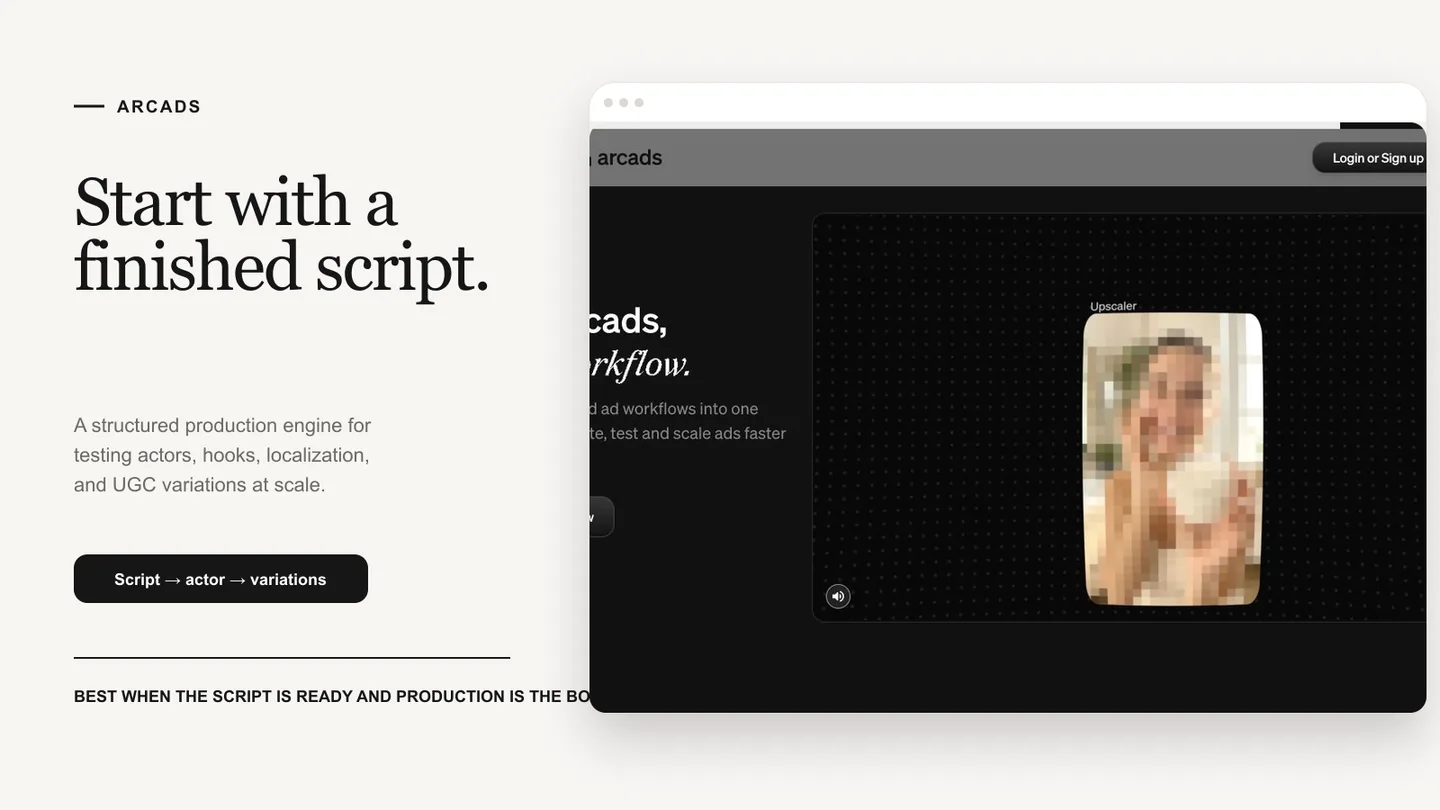
Arcads Create Workflow positioned as the platform for producing actor-led variations from a finished script
The limitation is not that Arcads lacks features. It is that its center of gravity is still production.
If you feed it a weak angle, generic customer insight, or a script that sounds like every other AI ad, producing 20 variations mostly gives you 20 polished versions of the same underlying problem.
My verdict: Choose Arcads when you know what you want to say and need an efficient actor-led production engine to say it in many different ways.
Starpop: best for an agent-led creative workflow
Starpop takes a different approach. Its most important feature is not an individual video model or avatar library. It is the AI chat agent sitting across the creative workflow.
Instead of beginning by selecting a model, you can start with the actual marketing problem:
Research why customers are unhappy with existing solutions, find the language they use, recommend three ad angles, and turn the strongest one into a 30-second UGC script.
The agent can continue working from that same context instead of handing you a block of text and making you rebuild everything somewhere else.
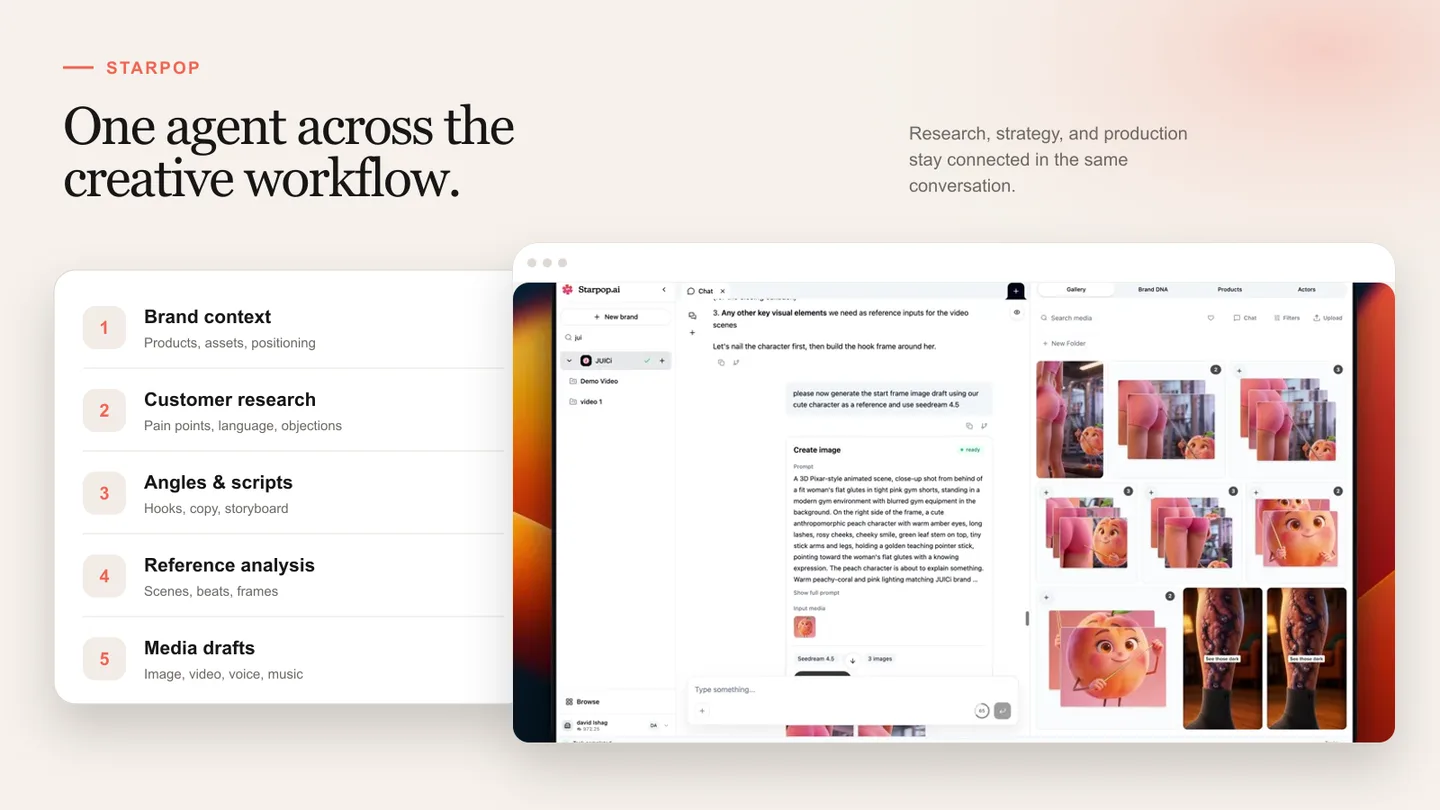
Starpop creative agent workflow moving from brand context and customer research through scripts, reference analysis, and media drafts
The Starpop agent can:
- Learn the brand, its products, positioning, imagery, and existing creative
- Research current web sources and public social conversations
- Surface customer pain points, failed solutions, objections, and desired outcomes
- Find the right products and assets in the workspace
- Analyze reference ads, including their transcript, shots, and frames
- Adapt a winning structure to another brand without copying its words
- Write hooks, scripts, static-ad copy, concepts, and storyboards
- Design consistent characters and recurring visual elements
- Stage image, video, speech, and music generations for review
- Search for voices, clone a supplied voice, and direct its delivery
- Carry finished media into the next step of the conversation
- Use reusable creative skills for formats such as UGC, animated characters, static ads, and song-style ads
The result feels less like moving through a collection of generators and more like working with a creative strategist who can operate the production tools.
One thread can move through:
- Customer and competitor research
- Brand and product analysis
- Angle selection
- Script and hook development
- Reference-ad analysis
- Storyboarding
- Character and image creation
- Video, voice, and music drafts
- Variations based on the finished output
The user still reviews important decisions and starts the generation. That distinction matters. The agent helps reason through and execute the workflow, but it is not a magic "profitable ad" button.
Starpop is especially suited to e-commerce because the agent works from a persistent Brand and Product Brain. It can combine what the company says about a product with what customers say in reviews, Reddit discussions, social posts, and competing ads. The Starpop product overview focuses on researching customer language, tracking competitors, and turning those findings into scripts and ads.
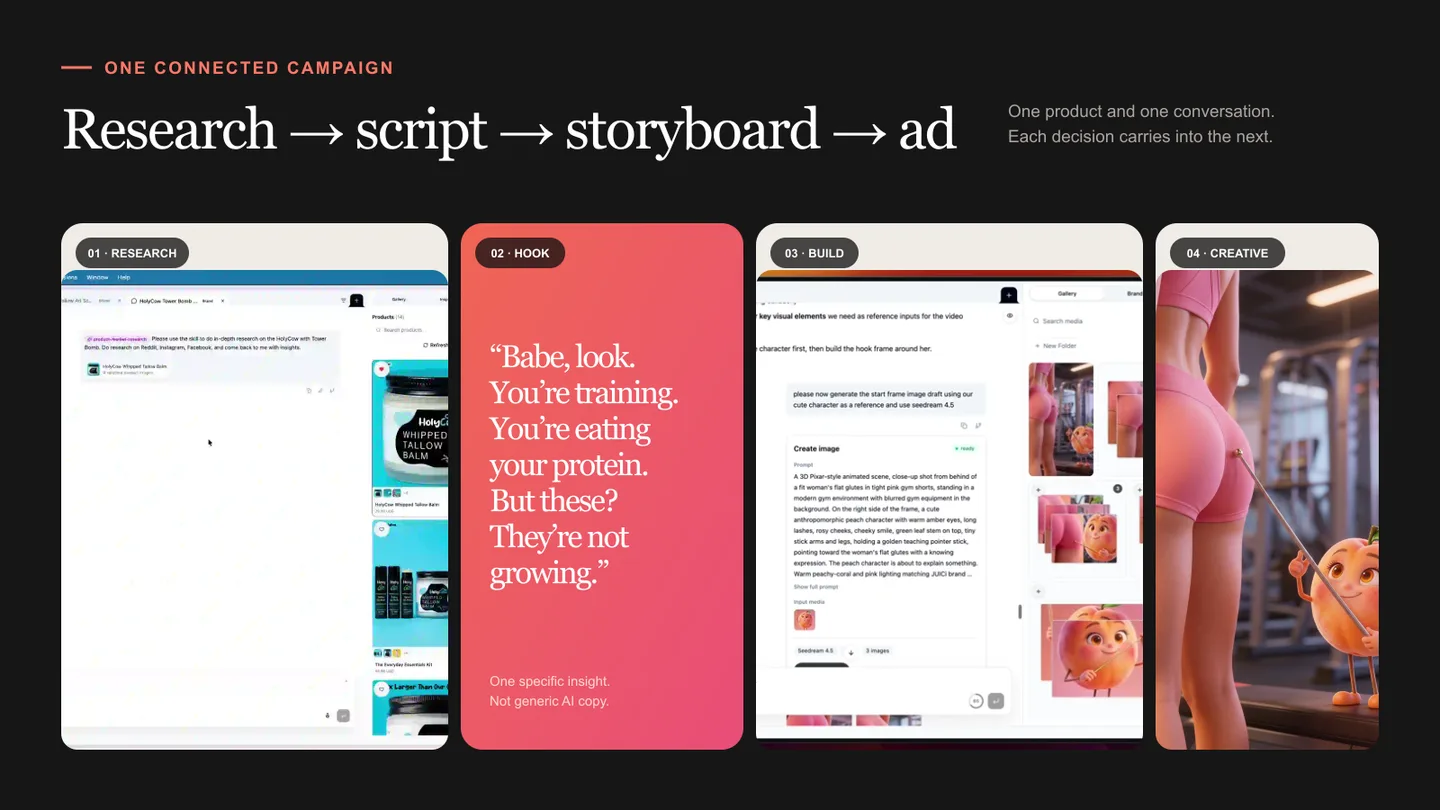
A single Starpop campaign progressing from customer research to a hook, creative build, and completed AI ad concept
A practical example is the animated-ad workflow. A reference ad can be broken into its script structure and individual scenes. The chat can research a new product, rewrite the concept around a real customer objection, design a recurring character, produce the start frame, and draft the video animation, all in the same conversation. This animated-ad walkthrough shows the process from research to video.
The main tradeoff is that chat is most valuable when the problem is still open-ended. If you already have the exact prompt, model, actor, and output settings in mind, working through an agent may feel less direct than opening a specialized generator.
My verdict: Choose Starpop when your bottleneck is not merely generating footage. Choose it when the hard part is researching the customer, finding an angle, writing the ad, maintaining context, and turning that strategy into finished creative.
Which AI ad platform should you choose?
Here is the simplest way I would make the decision.
For a broader multi-model comparison, see Top 10 Alternatives to Higgsfield I've Tested Myself.
Pick Higgsfield if you are starting with a visual idea
You know roughly what the ad should look like and want the widest range of cinematic, CGI, UGC, or product-focused ways to produce it.
Pick Arcads if you are starting with a script
You have the angle and copy. Now you need actors, voices, localization, editing, and a high volume of variations.
Pick Starpop if you are starting with a marketing problem
You have a product, but you still need to understand the customer, find the angle, study what is working, write the script, and carry the idea through production.
The part most comparisons miss
None of these platforms can guarantee that an ad will perform.
Production quality matters, but a polished video cannot rescue a weak offer, generic hook, or poor understanding of the customer. As the underlying image and video models improve, and as several platforms gain access to similar model families, the workflow around generation becomes more important.
Ask:
- Does the tool help me find a better angle?
- Does it understand my customer and product?
- Can it analyze the ads already working in my category?
- Can I preserve context across multiple iterations?
- How quickly can I turn one insight into ten meaningfully different creatives?
- What does each usable ad cost after failed generations and revisions?
That final question is more useful than comparing the cheapest subscription tier. The real metric is cost per creative you would actually put spend behind.
Final take
There is no universal winner.
Higgsfield has the strongest case as a wide-ranging visual production platform. Arcads is a natural choice for structured, actor-led UGC production. Starpop is the most interesting choice for marketers who want an AI agent involved in the thinking as well as the generation.
If your existing process already produces excellent concepts and scripts, Arcads or Higgsfield may give you exactly the production leverage you need.
If you are still bouncing between Reddit research, competitor ads, ChatGPT, script documents, image generators, video models, and voice tools, Starpop's chat-first approach solves a different, and arguably larger, part of the problem.
Try the Starpop creative agent with your own product: start creating with Starpop.