Contents
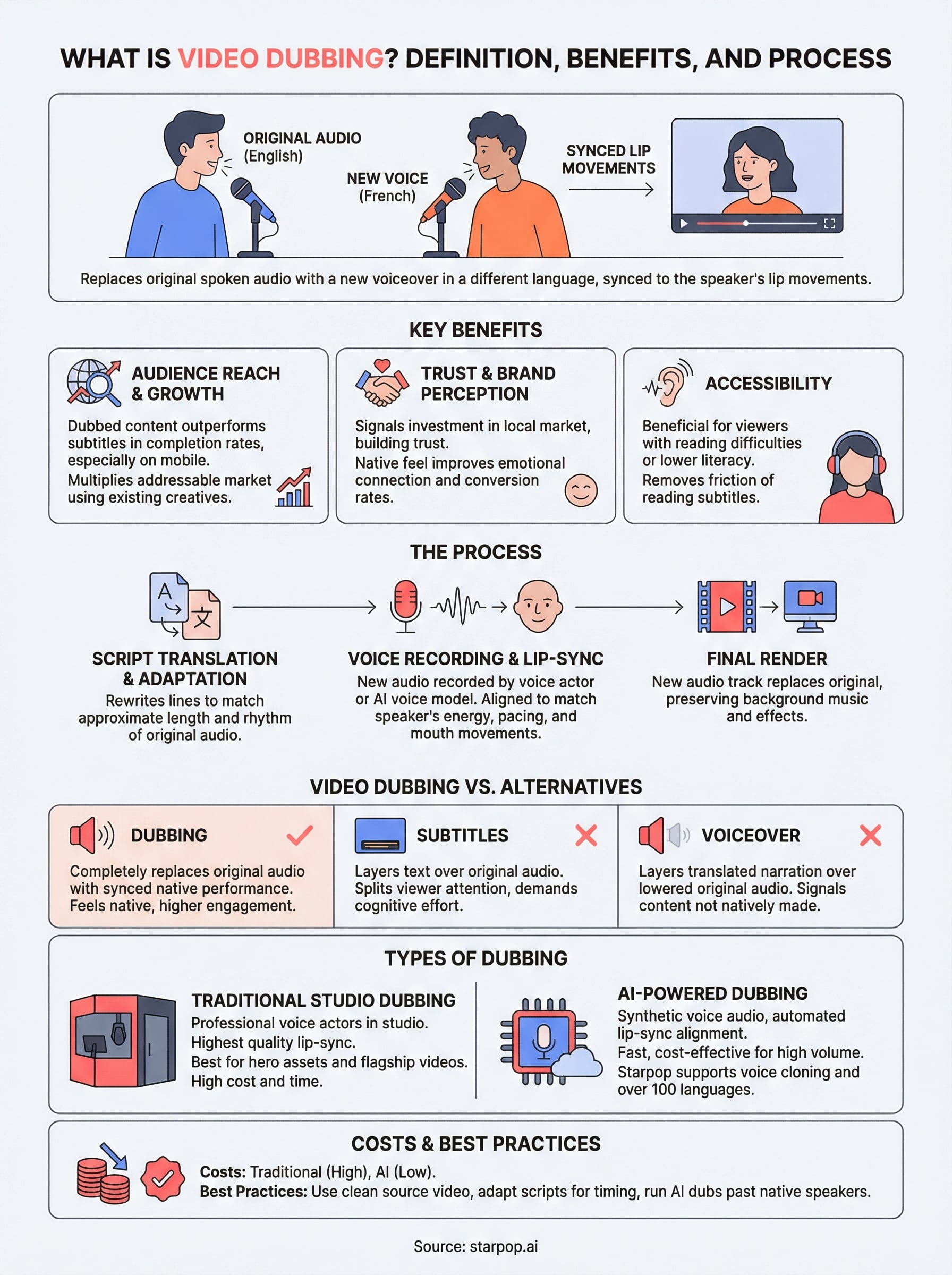
0%You recorded a product video that crushed it with your English-speaking audience. Now you want to run it in France, Japan, and Brazil, but subtitles alone won't cut it. That's where understanding what is video dubbing becomes essential. At its core, dubbing replaces the original spoken audio in a video with a new voiceover in a different language, synced to match the speaker's lip movements and timing as closely as possible.
For e-commerce brands and performance marketers producing ads at scale, dubbing isn't just a film industry technique anymore, it's a practical growth lever. A dubbed ad feels native to the viewer. It removes the friction of reading subtitles and keeps attention locked on your product, which directly impacts conversion rates across international campaigns.
This article breaks down exactly how video dubbing works, how it compares to subtitling, and where modern AI tools fit into the process. We'll also cover how platforms like Starpop, which supports voice cloning, studio-grade lip-syncing, and over 100 languages, make dubbing accessible without hiring voice actors or managing expensive localization workflows. Whether you're exploring dubbing for the first time or evaluating faster ways to localize video ads, you'll walk away with a complete picture.
Why video dubbing matters
When you understand what is video dubbing and apply it to your marketing strategy, you unlock audiences who would otherwise scroll past your content entirely. Subtitles demand cognitive effort from viewers, splitting their attention between reading text and watching visuals at the same time. Dubbed content removes that friction, letting your product demonstration, testimonial, or ad storyline land exactly the way you intended it to. For brands competing for attention in paid social feeds, that difference in cognitive load directly affects how much of your message actually gets through.
Audience reach and international market growth
The numbers behind multilingual video consumption are hard to ignore. Research from major streaming platforms consistently shows that dubbed content outperforms subtitled content in viewer completion rates, particularly among mobile users watching without headphones in noisy environments. For performance marketers running paid campaigns, higher completion rates feed platform algorithms directly, reducing your cost per result over time as the platforms reward engaging content with cheaper distribution.
Dubbing a top-performing ad into three target languages can multiply your addressable market without producing a single new creative concept.
Your existing creative library holds untapped value right now. If a video ad converts well in English, the same hook, the same product demonstration, and the same call to action can work in German, Portuguese, or Korean with proper dubbing. You are not starting from scratch. You are scaling what already works into markets your competitors may not have reached yet, using assets you already paid to produce.
Trust and brand perception across markets
Audiences connect more deeply with content that sounds like it was made specifically for them. A dubbed video signals that your brand invested in the local market, rather than simply layering a quick translation on top of a generic asset. That perceived investment builds trust, and trust shortens the buying decision for new customers who have never heard of your brand before.
This principle applies equally to long-form product explainers, UGC-style ads, and short-form social content. A viewer in Japan who hears your product pitched in natural Japanese, with proper pacing and regional tone, processes the message differently than someone reading subtitles in a second language. The emotional resonance is measurably stronger, which matters when you have a few seconds to drive a purchase decision.
Accessibility adds another layer to the case. Viewers with reading difficulties or lower literacy in their native language benefit from audio-first content. Dubbing makes your video accessible to a broader segment within any target market, including older demographics who are increasingly active online buyers but less comfortable consuming subtitle-heavy formats at speed.
How video dubbing works step by step
Understanding what is video dubbing at a process level helps you make smarter decisions about timelines and quality expectations. The workflow moves through distinct phases, and each one affects the final result. Skipping or rushing any phase creates problems that compound later, so knowing what happens at each stage keeps your localization projects on track.
Script translation and adaptation
The first step converts your original script into the target language, but a direct word-for-word translation rarely works. A professional adapter rewrites lines so they match the approximate length and rhythm of the original spoken audio. This matters because different languages take different amounts of time to say the same thing. French typically runs longer than English, for example, while Japanese can compress meaning into fewer syllables. Adapting the script to fit the timing of the original performance is what separates usable dubbing from an awkward final product.
Voice recording and lip-sync matching
Once the adapted script is ready, a voice actor or AI voice model records the new audio. The recording session focuses on matching the original speaker's energy, pacing, and emotional tone rather than just delivering accurate words. After recording, the audio gets aligned to the video timeline so the spoken words land close to the visible lip movements on screen.
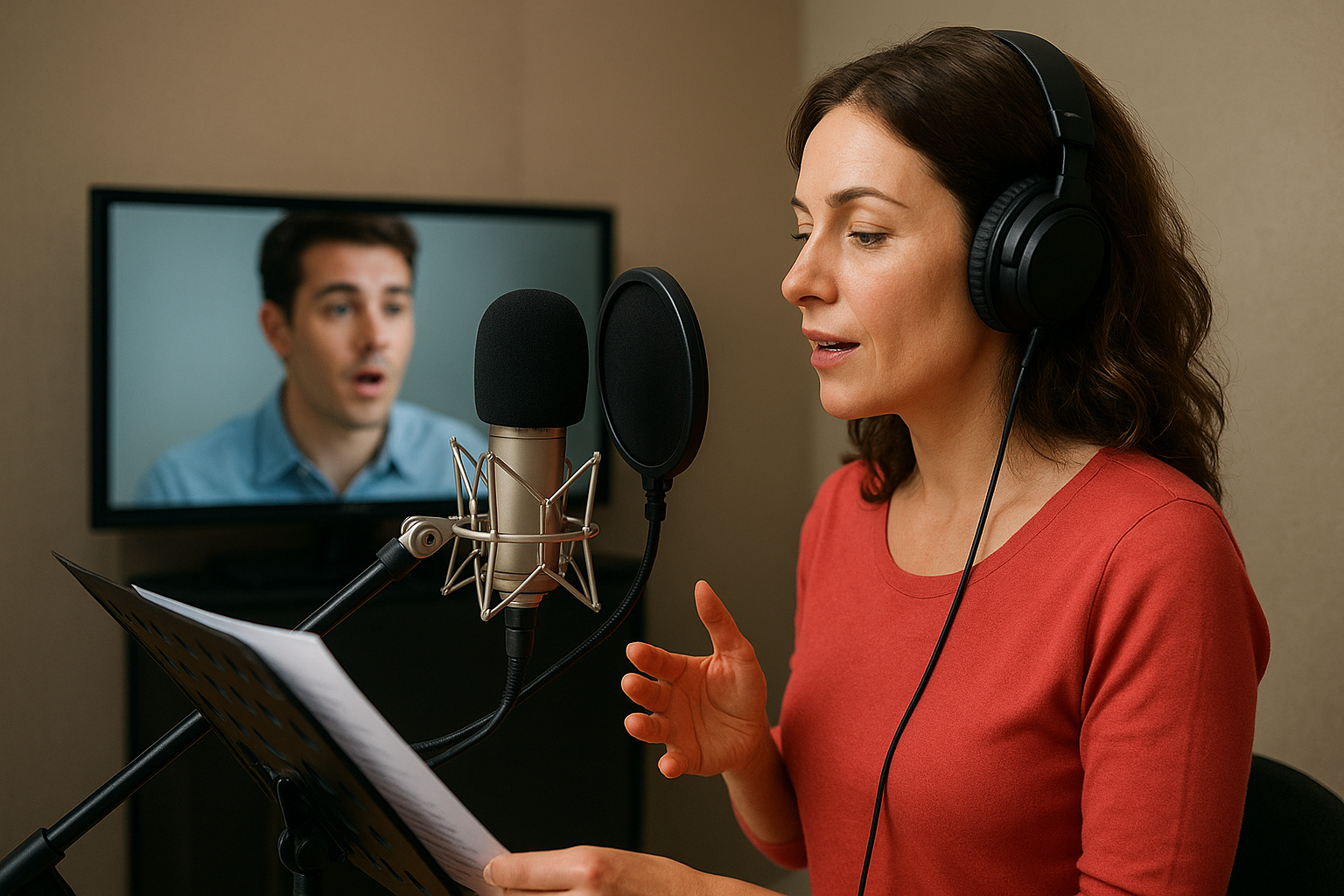
Lip-sync accuracy is the single biggest factor viewers use to judge whether dubbed content feels natural or distracting.
Modern AI dubbing tools handle this alignment automatically by analyzing mouth movement patterns in the source video and adjusting the generated audio to match. The final step renders the new audio track into the video file, replacing the original language track while preserving background music, sound effects, and ambient noise at the correct volume levels.
Video dubbing vs subtitles and voiceover
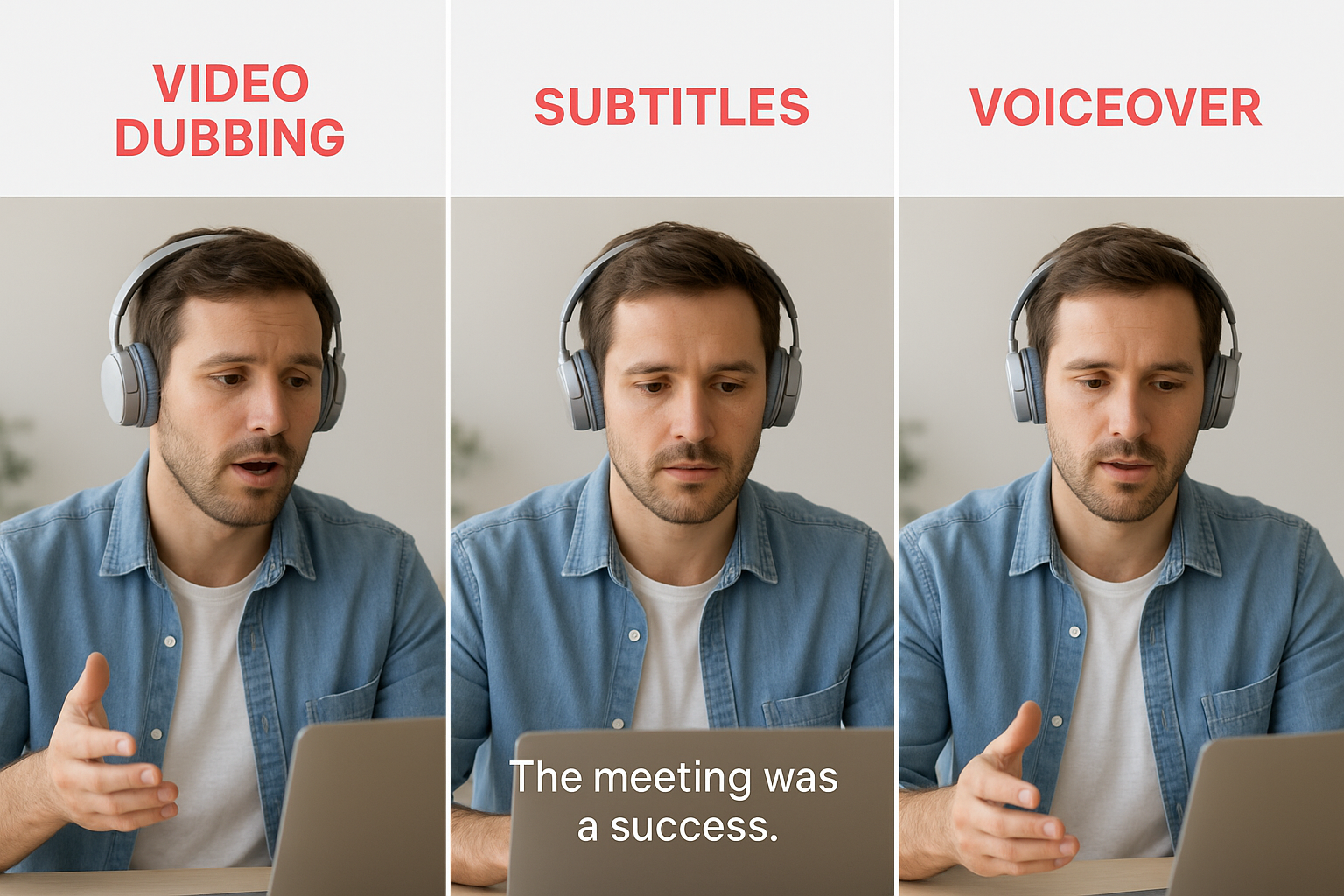
When you evaluate localization options, three methods come up most often: dubbing, subtitles, and voiceover. Knowing what is video dubbing compared to the alternatives helps you pick the right format for each campaign goal. Each method carries a different cost, production complexity, and effect on viewer experience, so the right choice depends on your audience, platform, and budget.
Subtitles: readable but demanding
Subtitles keep your original audio intact and layer text at the bottom of the screen. They cost less to produce and deliver faster than any other localization method, which makes them a common default. The real trade-off is that they split viewer attention between reading and watching simultaneously, reducing how much of your message actually lands.
Subtitles work well for scripted interviews or documentary content, but they consistently underperform dubbed video in paid social environments where attention is scarce.
Beyond the attention problem, subtitles exclude viewers with reading difficulties or low literacy in the target language, which shrinks your effective reach within that market without you realizing it.
Voiceover vs dubbing
Voiceover layers a translated narration track over the original audio, typically lowering the source volume rather than replacing it entirely. You often hear this format in news segments and corporate training videos. The original speaker's voice remains faintly audible underneath, which signals to viewers that the content was not originally made for them.
Dubbing takes a different approach by completely replacing the original audio with a fully synced performance in the target language. Viewers hear nothing from the original track, and when the lip-sync is accurate, the content feels as if it was recorded natively. For performance-driven ad campaigns, that native feel produces stronger emotional connection and higher conversion rates than voiceover or subtitles can reliably deliver.
Types of video dubbing and when to use each
Not every dubbing project requires the same approach. Understanding what is video dubbing at a format level helps you match the right method to your specific campaign type, budget, and turnaround time. Choosing the wrong format wastes resources and creates rework, so knowing the distinctions upfront saves you both.
Traditional studio dubbing
Traditional dubbing brings professional voice actors into a recording studio to perform the adapted script live against the video playback. Directors guide the performance to match the original speaker's emotional tone and timing, and engineers mix the recorded audio against the original sound design. This method delivers the highest possible lip-sync accuracy and vocal quality, which is why film studios and major streaming platforms still rely on it for premium content. If you are dubbing a brand film or a high-production hero video that will run across broadcast channels, traditional studio dubbing gives you the quality ceiling your content demands.
The tradeoff is time and cost: a traditional session for a single two-minute video can take days to complete and requires coordinating multiple specialists.
AI-powered dubbing
AI dubbing generates synthetic voice audio from a cloned voice model or text script, then automatically aligns the output to match mouth movements in the source video. The process runs in a fraction of the time traditional studio sessions require and costs significantly less per asset. For e-commerce brands running high-volume ad campaigns across multiple markets, AI dubbing is the practical choice. You can localize dozens of video variations into several languages within a single workflow, which lets you test localized creatives at the same pace you test English-language assets without stretching your production budget.
Costs, quality, and AI dubbing best practices
Once you understand what is video dubbing and the formats available, the next question is what it actually costs and how to protect quality as you scale. Traditional studio dubbing typically runs between $500 and $2,000 per finished minute depending on the language pair, voice talent rates, and studio location. AI dubbing drops that cost dramatically, often to a fraction of a dollar per minute on credit-based platforms, which makes localization viable even at high content volume.
Matching your budget to your content tier
Not every video in your library deserves the same investment. Reserve traditional studio production for hero assets: brand films, high-spend campaign launches, and flagship product videos that anchor your funnel. For ad variations, split-test versions, and short-form social content, AI dubbing delivers strong quality at a fraction of the cost and lets you test across markets without burning through your production budget.
Spending premium budget on every asset slows your testing velocity and limits how many markets you can enter at once.
Think of your content in tiers. High-investment assets run fewer times but carry your brand story, while high-volume AI-dubbed variations run frequently to identify the winning creative for each market. Keeping those tiers separate protects both your quality standard and your overall localization spend.
Best practices for AI dubbing quality
Your source video quality sets the ceiling for your dubbed output. Start with clean recordings where the speaker's mouth is clearly visible, since AI lip-sync models depend on accurate mouth movement detection to align audio correctly. Keep adapted scripts close to the original in length and pacing.
Before publishing any AI-dubbed ad, run each language version past a native speaker to catch unnatural phrasing that automated systems sometimes miss. This single review step prevents poorly localized content from reaching paid audiences and damaging your brand in markets you are just entering.
Key takeaways
Now that you understand what is video dubbing and how it fits into a modern localization strategy, the path forward is straightforward. Dubbing replaces original audio with a fully synced target-language track, giving international viewers content that feels native rather than translated. That difference in viewer experience consistently produces stronger engagement and higher conversion rates than subtitles or voiceover can deliver.
Your existing top-performing videos are already a ready-made asset library for global expansion. Dubbing them into additional languages lets you scale what already converts without rebuilding your creative from scratch. Use traditional studio dubbing for flagship assets and AI dubbing for high-volume ad variations, split tests, and new market entries where speed and cost efficiency matter most. Always review AI-dubbed output with a native speaker before publishing to keep quality consistent.
Ready to localize your video ads at scale? Try AI dubbing on Starpop and reach new markets without the production overhead.